
You already knew your daughter wasn’t the only one. You can see it in our community every day: girls who held it together all through primary school and then could not get through the gates in Year 8, and parents taking calls about attendance percentages from people who have never asked why.
Now there is national data, and it says what families have been saying for years.
What the research found
Chloe Eddy, Sarah Parsons and Hanna Kovshoff at the University of Southampton published their study in the journal Autism in November 2026. They looked at ‘persistent absence’, which the Department for Education defines as missing 10% or more of school sessions in a year. That is 38 sessions, or 19 school days.
You will see ‘persistently absent’ in inverted commas throughout this piece. It is the government’s term and the one the figures are collected under, so we have to use it to report them accurately. We don’t like it, because ‘persistent’ makes absence sound like a habit or a choice and puts the problem in the child. The measure also counts every missed session the same way, whatever the reason, and nobody records why. We talk about Barriers to Attendance, because that asks the question the label skips: what is getting in her way?
Their figures cover every state-funded mainstream primary and secondary school in England between 2016/17 and 2022/23.
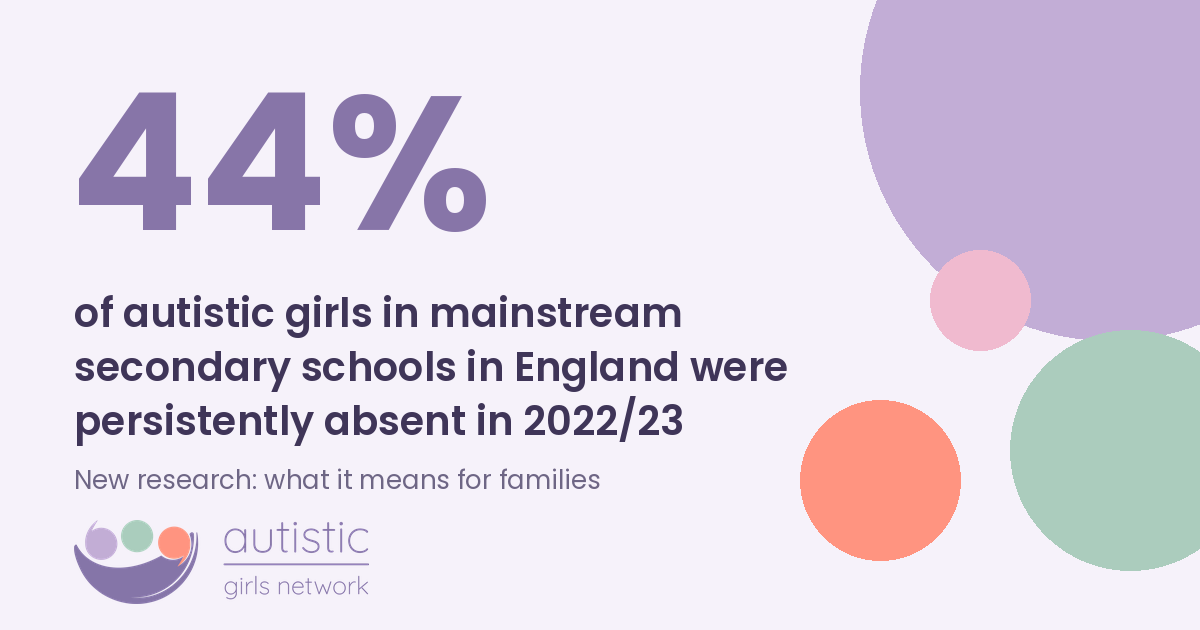
In 2022/23, 44.26% of autistic girls in mainstream secondary schools were ‘persistently absent’. That is more than 7,800 girls.
Here is how that compares with other young people in the same schools in the same year:
- Autistic girls: 44.26%
- Autistic boys: 31.34%
- Girls with no identified special educational needs: 25.40%
- Boys with no identified special educational needs: 22.05%
The figure for autistic girls has nearly doubled. In 2016/17 it was 22.98%.
The gap between autistic girls and autistic boys has more than doubled too, from under 6 percentage points to almost 13.
And it is starting younger. In primary schools, 28.10% of autistic girls were ‘persistently absent’ in 2022/23, up from 15.38% in 2016/17. Before the pandemic there was little difference between autistic girls and autistic boys at primary age. Since 2021/22 a gap has opened. It is small, but it was not there before.

Why nobody could see these figures
The researchers had to use a Freedom of Information request to get them. The Department for Education publishes attendance for children with special educational needs as one group. It doesn’t break the figures down by type of need and sex together, so autistic girls disappear into an average. The authors describe them as a group at risk of being “statistically forgotten”. A group that isn’t counted doesn’t get planned for.
The real number is higher
44% is only the girls the data can see. It does not include:
- girls on part-time timetables
- girls who have moved to alternative provision or home education, often because there was no other option left
- girls in special schools
- girls still waiting for an assessment, or whose school records autism as a secondary need
Schools also record sex as girl or boy only, so trans, non-binary and gender-diverse young people are not visible in these figures at all. The authors name that as a gap future research needs to fill.
Many of the families in our community are in one of those groups. Their daughters are not in the 44%.

Absence is the signal
The study can’t tell us why. It counts absence across the whole country and doesn’t follow individual girls, and the authors are clear about that limit. What they do say is that ‘persistent absence’ in an autistic girl should be read as a possible sign of unmet support needs, and should not be handled as an attendance or behaviour concern alone.
The research they draw on describes what families describe to us. Needs go unnoticed for years because she masks at school and looks as though she is managing. Support comes late or doesn’t come. Leaving is slow and gradual, and it is usually the last thing a family does, when keeping her there is putting her at risk.
Masking isn’t coping.
The pandemic widened the gap but didn’t create it, because autistic girls were already more likely to be ‘persistently absent’ in 2016/17. Other studies cited in the paper found that some autistic young people felt better when the demand to attend lifted, and that going back to a school that hadn’t changed was the hard part.

What helps
The paper points to research on what brings autistic girls back into learning: relationships with adults who understand them, flexibility, a school culture that accepts them, and access to specialist support. It also notes that teachers’ knowledge of autistic girls has been described as insufficient.
That is why we train schools, and why we built The Haven, our online school for young people who cannot attend mainstream
What needs to change
- The Department for Education should publish attendance by type of need and sex every year, so nobody needs a Freedom of Information request to find autistic girls.
- The girls who have already left should be counted too, including those on part-time timetables and in home education.
- Schools should treat falling attendance in an autistic girl as a reason to ask what isn’t being met, before the attendance letters start.
- Support should begin in primary school, because that is where this now starts.
If this is your daughter
You have not failed her, and she has not failed. She is one of thousands of girls in a system that was not built with her in mind.
37,000 families are in our Facebook support group, and many of them have stood exactly where you are. Join us there.
If you work in a school and want to understand what sits behind these numbers, our training for schools is here.
Read the full paper: Eddy, C. G., Parsons, S. and Kovshoff, H. (2026) Patterns of persistent absence among autistic girls in state-funded primary and secondary mainstream schools in England from 2016/2017 to 2022/2023. Autism. https://doi.org/10.1177/13623613261503617


Leave A Comment